Every factory its own colors
Each factory got its own palette, the machines got a little worn, and the belts finally stand on legs.
The stockpiles inside a factory used to show a few baked stages, a small heap for a little stock and a bigger heap for a lot. Now they show the real thing. Every log sitting in one is its own log, stacked five along, two deep and two high inside a low railing, with a sign on the end that holds the thing the pile is for. It took two tries: my first version read how full the pile was from the wrong place and floated the logs next to it. The log is also one model everywhere now, on the belts, in the claws and on the piles, just shrunk to fit. And the haulers walk around with whatever they carry on their heads.
Then the bigger job. Every factory interior was the same gray room, so I gave each factory its own colors. The sawmill got a warm wooden floor and brown walls with green machines, the smelter coal and fire, the machine shop blue, the bakery something bright, and the belt workshop a dark room so the yellow belts stand out in it. A machine takes the paint of the factory it belongs to, but only on its body. My first pass painted the saw blade too, and that was plainly wrong: a blade is metal. Belts stay safety yellow in every factory, and the stockpiles keep a green stripe for input and an orange one for output. The inserters started out yellow as well, and they looked huge and loud, so now they are black with a red gantry. I worked the colors out on a palette page first.
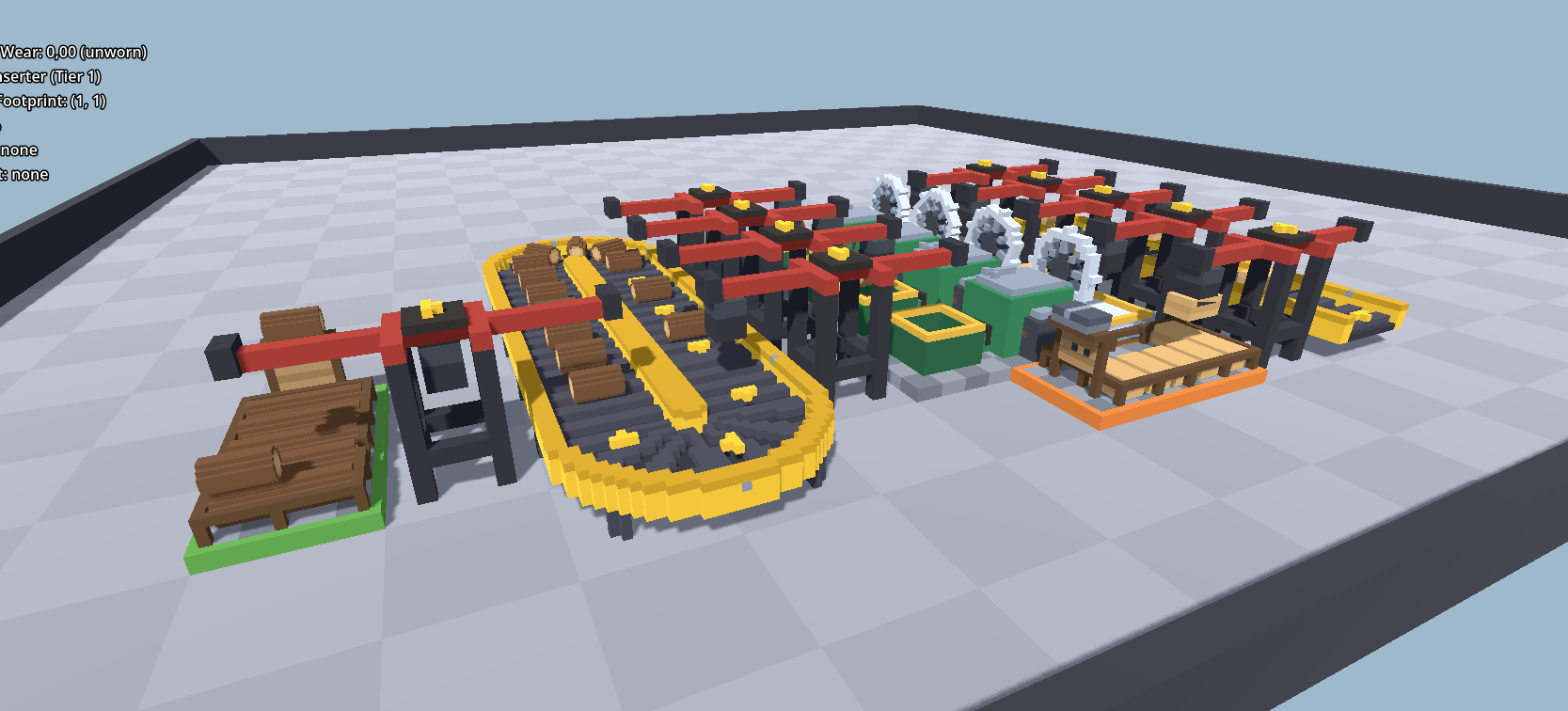
I also wanted things to look less factory fresh. My first try gave every block a slightly different shade, grime along the bottom, rust patches and rows of rivets. It did not read as old, it read as noise, and it made the models many times heavier to draw. So I threw most of it out. Each model now comes in three worn versions with only a few marks: at most three small dots on a machine inside a factory, at most five marks on a building outside, a rust spot, a paint chip, a darker plank. A few also get a small prop, sawdust by the cutter, a wrench left on top, a sign knocked crooked. Every placed piece picks one version once and keeps it, also after saving and loading. Checking all this turned up a few spots where a moving part sat inside a machine’s body and the two flickered against each other; those are gone now.
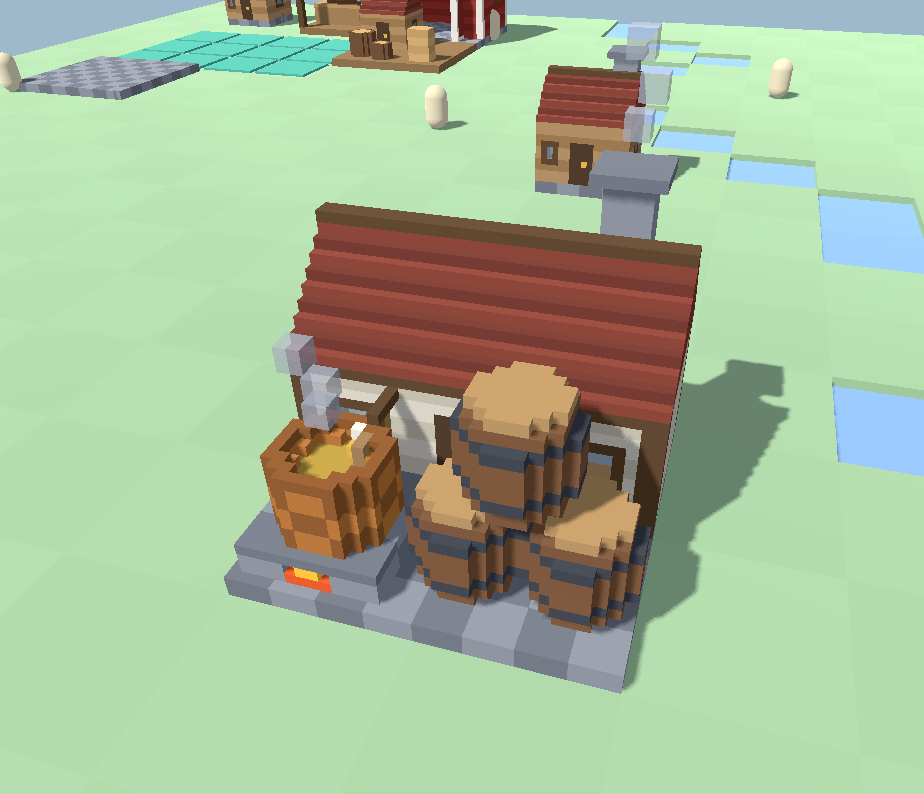
The brewery never had a model at all, so it got one: a plaster brewhouse with a smoking chimney, a copper kettle steaming over a glowing hearth, and a stack of barrels.
Last, the belts. They used to sit on a solid block, now they stand on iron legs. And the little arrow that shows which way a belt runs always looked slightly off. A tile is sixteen blocks wide, so its exact middle falls between two blocks, and an arrow three blocks wide can never sit centered on it. The fix was to make the arrow its own tiny model that the game places at the true middle of the tile. The inserters use the same arrow now, and it turns out theirs had been half a block off all along.