A menu that remembers
A new main menu: every new game gets its own town name, saved towns show a picture of their map, and old saves can be cleaned up.
Until now the game had one save slot that you could name, and saving under the same name again simply wrote over it. That is fine for testing and bad for playing: one wrong click and the town from last night was gone. So the saves got rebuilt from the bottom up, and the main menu with them.
Every save is now a new file with its own time. Only the autosave writes over itself. Each game lives in its own folder with a small file that says what it is: its name, its seed and its map. And every save starts with a short header, the town’s name, the day and the number of people, so the load list only has to read the first few kilobytes of each file instead of the whole world. The folder is the only truth. If a save ends up in the wrong game’s folder, the game moves it to the right one instead of getting confused.
A new game now opens a small window that already has a name for your town, picked from the seed: Copperbrook, Lantern Hope, Kettle Crossing. A name that one of your saved games already uses can’t start, so two towns never share a name. The load list shows one card per town with a picture of its map as it was at the last save. That picture is taken by a second camera on the same world, so the HUD is never in it. The older saves of a town are one dropdown away.
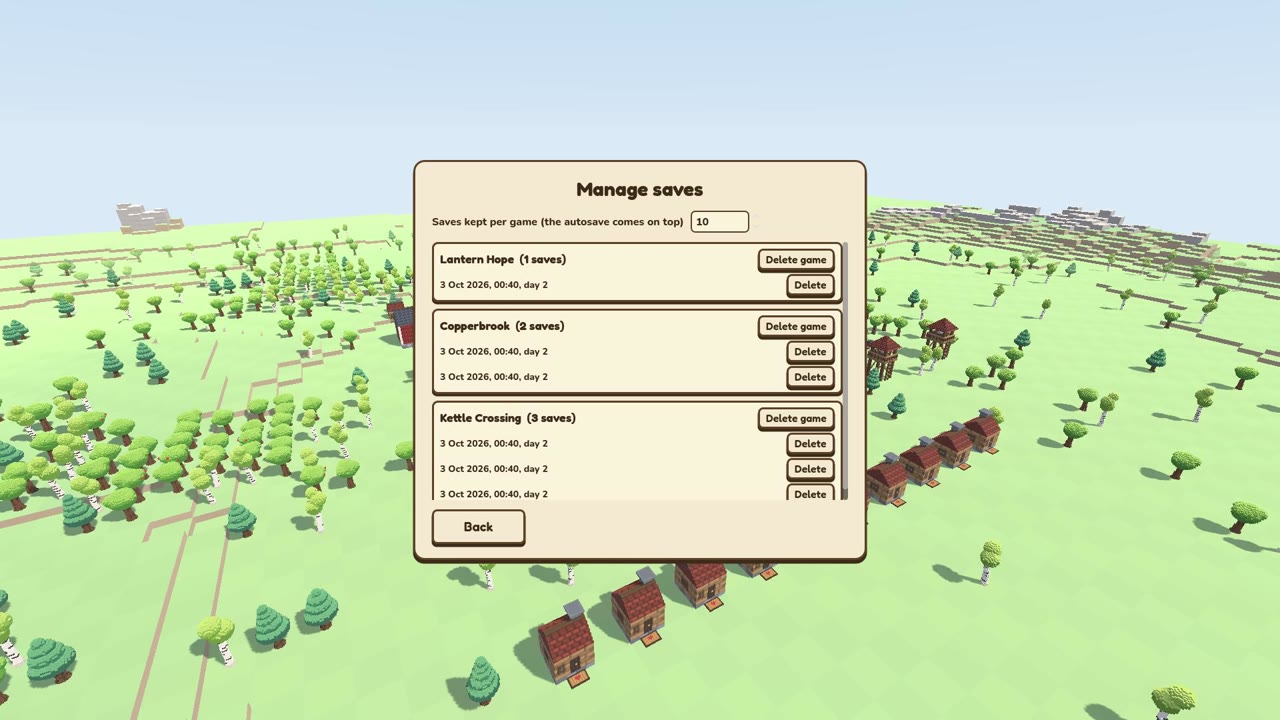
Manage saves is where the pile gets cleaned up. You can delete one save or a whole town, and a second click within three seconds confirms it, so nothing goes on one stray click. There is also a number for how many saves to keep per town, ten by default. When a town has more, the oldest go first, and the autosave comes on top of that.
The settings window got its padding back, so the text no longer touches the edges, and the master volume now really starts at half.